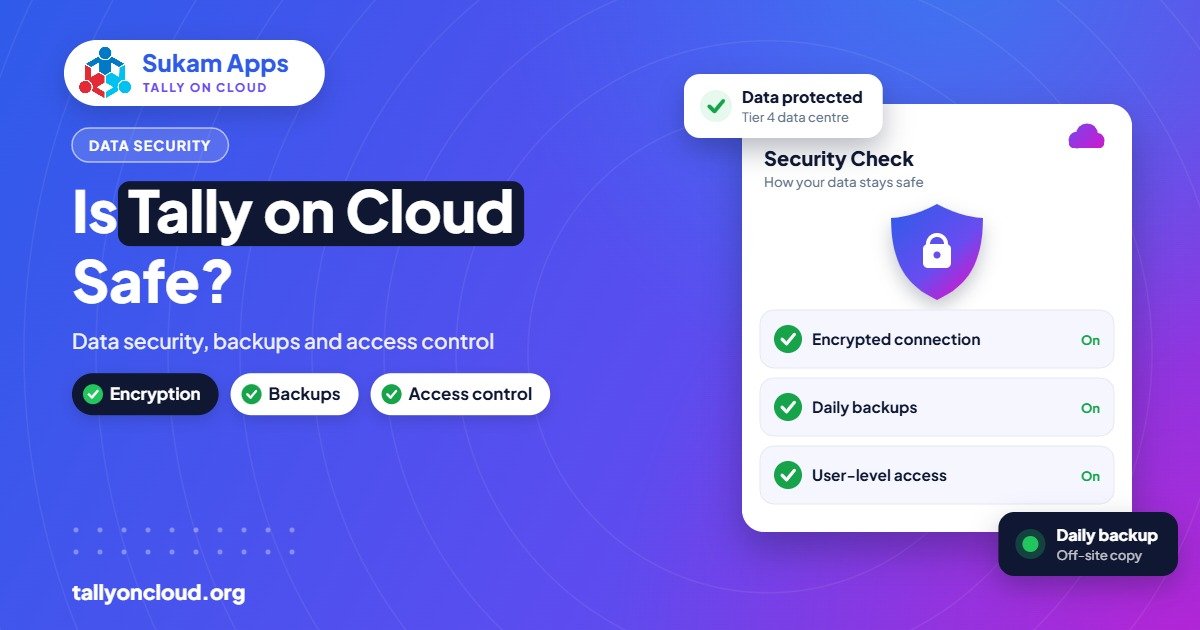
Yes, Tally on Cloud is safe when it is set up properly: encrypted connections, individual logins with two-factor authentication, TallyPrime user rights, and daily backups stored away from the main server. In many small businesses it is actually safer than an office PC that sits under a desk with no backup and a shared password. Tally cloud security depends far more on the setup and the provider’s habits than on the word “cloud” itself.
Below, we explain each layer of protection in plain language and give you a checklist of questions to ask any provider.
Why Owners Worry, and What the Real Risks Are
Your Tally data holds everything: sales, purchases, bank balances, party outstanding, salaries. It is natural to feel nervous about letting it leave the office. But it helps to look honestly at where data is actually lost in small businesses in Punjab and across North India:
- A hard disk fails, and the last backup is four months old.
- A virus or ransomware locks every file on the office PC.
- A laptop with Tally data is stolen from a car.
- An ex-employee still knows the shared Tally password.
- Power fluctuations corrupt a company during a long data save.
- Someone copies the data folder onto a pendrive and walks away.
Notice that none of these need the cloud to happen. A well-run cloud setup is designed to reduce exactly these risks. A badly run one can still have them. So the question is not “cloud or no cloud” but “how well is it done?”
The Layers of Tally Cloud Security
Good security is not one feature. It is several layers, so that if one fails, the next one still protects you.
1. Encrypted connection
When your accountant connects to the server through Remote Desktop (RDP), RemoteApp or a secure browser gateway, the session is encrypted. Someone sitting on the same café Wi-Fi cannot read your ledgers in transit. Ask the provider to confirm that connections are encrypted and that the server is not left open with weak default settings.
2. Individual logins for every user
Each person should have their own username and password to reach the server. Never accept a single shared login for the whole office. With individual logins, you can remove one person’s access the day they leave, without changing everything for everyone else.
3. Two-factor authentication (2FA)
A password alone can be guessed or leaked. With 2FA, the user also needs a one-time code from their phone. Even if a password reaches the wrong person, they still can’t get in. For owners and senior accountants, 2FA should be non-negotiable.
4. TallyPrime security levels
Inside TallyPrime, you can create users with specific security levels. A dispatch clerk can be allowed to make delivery notes but not see the profit and loss account. A CA can be given view and report access. A salesman can check stock but not change rates. Set this up once and review it every few months.
5. Edit Log (audit trail)
Since 1 April 2023, companies covered under the Companies (Accounts) Amendment Rules must keep an audit trail of changes to their books. TallyPrime’s Edit Log records who created, changed or deleted a voucher. Beyond compliance, this is a strong deterrent against internal fraud. If someone alters an entry, there is a record.
6. Daily backups, stored separately
Backups are your last line of defence. A good Tally on Cloud setup takes daily automatic backups on the server side and keeps several days of restore points, so you can go back to yesterday or last week if needed. Backups should be stored separately from the live server, so a single failure doesn’t take both.
7. TallyDrive as an extra copy
TallyPrime 7.0, released on 19 December 2025, introduced TallyDrive. With active TSS, you get free TallyDrive storage and automatic background backups, and you can restore earlier versions. Using TallyDrive alongside the provider’s own server backups gives you two independent copies, which is exactly what you want.
8. Server hardening and updates
The provider should keep Windows patched, run antivirus, restrict which programs can run, and block unused ports. This is boring, regular work, and it is exactly what most office PCs never get.
Cloud vs Office PC: A Security Comparison
| Risk | Typical office PC/server | Well-managed Tally on Cloud |
|---|---|---|
| Hard disk failure | Data lost if no recent backup | Restore from daily backup |
| Ransomware on a staff PC | Can encrypt local Tally data | Data sits on the server, not the staff PC |
| Laptop stolen | Data travels with the laptop | No company data stored on the laptop |
| Ex-employee access | Shared password often never changed | Individual login disabled in minutes |
| Power cut during save | Risk of data corruption | Server has power backup in the data centre |
| Pendrive copying | Easy to copy the data folder | Can be restricted by the provider |
For a broader comparison beyond security, read Tally on Cloud vs office server/LAN.
Where Is Your Data, and Who Can See It?
This is the question owners rarely ask, but should. Your provider manages the server, so in principle their administrators have technical access to it. That is true of any hosting, email or banking service you use. What matters is:
- A clear agreement that your data belongs to you and will not be accessed except to support you.
- Separation between clients on shared servers, so another business cannot see your folders.
- Data in India, if that matters to you. Ask where the server is located.
- A clean exit: the right to take a full copy of your data whenever you want, and deletion from the server when you leave.
India’s Digital Personal Data Protection (DPDP) Act also puts more focus on how businesses handle personal data such as customer and employee details. Your Tally holds some of this, like party contacts and payroll. A provider who takes access control and data handling seriously makes your own responsibilities easier to meet.
Questions to Ask Any Tally Cloud Provider
Before you sign up, ask these and expect clear answers:
- Is every user given an individual login? Is two-factor authentication available?
- Are connections encrypted? Which access method do you use?
- How often are backups taken, how many days are kept, and where are they stored?
- How quickly can you restore an older backup if we ask?
- Are different clients’ data folders separated on a shared server?
- Where is the server located?
- Who on your team can access our server, and why?
- If we leave, how do we get our full data, and how is it deleted?
- Who do we call if we suspect a security problem, and how fast will they respond?
A provider who hesitates on these questions is telling you something.
What You Must Do on Your Side
Even the best server can be undone by careless habits in the office. Your team should:
- Never share passwords or write them on a sticky note on the monitor.
- Turn on 2FA for owners and senior accountants at least.
- Remove access the same day someone leaves.
- Keep the staff PCs and phones updated, with screen locks on.
- Review TallyPrime user rights every quarter.
- Avoid logging in from shared or public computers.
A Chandigarh CA firm handling forty client companies, or a Baddi pharma unit with batch and expiry data, has the most to gain from getting these basics right. For CA-specific setups, see Tally on Cloud for CA firms.
New to the idea? Start with our complete guide to Tally on Cloud.
Frequently Asked Questions
Is Tally on Cloud safe for confidential accounts data?
Yes, when it uses encrypted connections, individual logins with 2FA, TallyPrime user rights and regular separate backups. In many cases it is safer than a single office PC with no backup routine.
Can the cloud provider see my Tally data?
Server administrators have technical access, as with any hosting service. A trustworthy provider agrees in writing that your data belongs to you and is accessed only to support you.
What happens if the cloud server crashes?
Your data is restored from the latest backup. That is why daily backups stored separately from the live server are essential. TallyDrive, with active TSS, adds another independent copy.
Does TallyPrime have an audit trail for compliance?
Yes. TallyPrime’s Edit Log records changes to vouchers and masters and helps companies meet the audit trail requirement that applies from 1 April 2023.
Can I stop an ex-employee from accessing Tally on Cloud?
Yes. Because every user has an individual login, you or your provider can disable that one login immediately, without affecting anyone else.
Secure Tally on Cloud from Sukam Apps
Sukam Apps, Jalandhar, has been working with businesses since 2011. We set up Tally on Cloud with individual logins, daily backups, TallyPrime user rights and local printing, and train your staff in Hindi or Punjabi on-site across Punjab, Chandigarh Tricity, Haryana, Delhi NCR and Himachal (Baddi, Solan). Elsewhere in India, a dedicated account manager handles you remotely. WhatsApp +91 99142 49191 for a free demo and a quote for your user count.