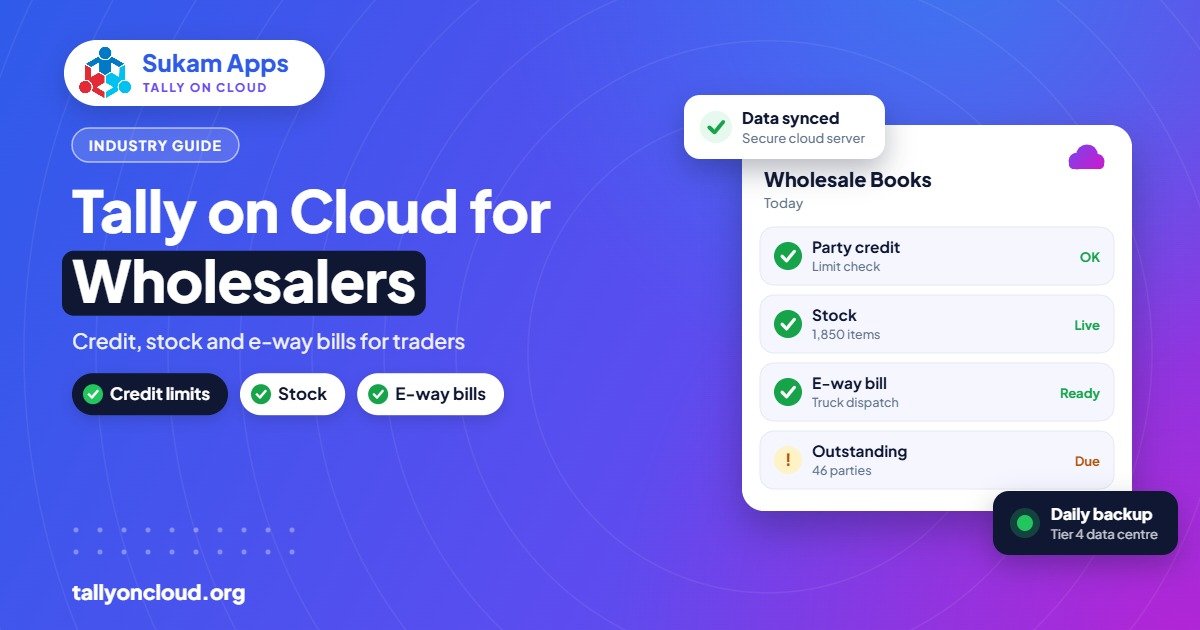
Tally for wholesalers is most useful when it is set up to answer three daily questions: who owes us money and for how long, how much stock is where, and whether this dispatch needs an e-way bill. TallyPrime handles all three, and running it on the cloud lets your counter, godown, salesmen and accountant work on the same live books from different places. Below is a practical setup and daily routine for wholesale and trading businesses.
The examples come from the kinds of trades we see across North India: hardware and sanitary dealers, FMCG and grocery wholesalers, cloth merchants, electrical distributors, steel traders around Mandi Gobindgarh and sports goods wholesalers in Jalandhar.
The real problem in wholesale is credit, not sales
Most wholesalers do not struggle to sell. They struggle to collect. A typical pattern: sales grow, the outstanding grows faster, and one day a few large retailers are sitting on months of unpaid bills. Fixing this starts with how party ledgers are set up in Tally.
Turn on bill-wise details for every customer
In each Sundry Debtor ledger, keep bill-wise details on, with a default credit period. Every sales invoice then becomes a separate “bill” that receipts are matched against. Without this, you only know a party’s total balance, not which bills are old.
Set credit limits
TallyPrime lets you set a credit limit on a party ledger. When a new invoice would push the party beyond that limit, TallyPrime alerts the billing user instead of letting it pass silently. This single setting stops a lot of over-supply to slow payers. Decide the limit per party based on payment history, and review it every quarter.
Use the outstanding and ageing reports weekly
- Bills receivable shows each pending bill and how many days overdue it is.
- Ageing analysis groups outstanding into buckets such as 0–30, 31–60, 61–90 and 90+ days.
- Party-wise outstanding is what a salesman needs before visiting a shop.
A routine that works: every Monday, the accountant prints or shares the 60+ day list; salesmen get their own parties’ list; the owner reviews the 90+ list personally.
Stock control across counter and godowns
Wholesalers rarely keep all their stock at the shop. Create a godown in TallyPrime for every storage point, plus useful logical locations:
- Shop / Counter for display and quick sales.
- Main Godown for bulk stock.
- Damaged / Returns for goods that cannot be sold as new.
- In Transit for stock that has left one location but not reached another.
Then follow two habits:
- Every transfer between locations is entered as a stock transfer (stock journal or delivery note, as per your setup), not just moved physically.
- Purchases are entered at the godown where goods are actually received, by the person who received them.
The second habit is only practical when the godown can log in to Tally itself. That is where cloud comes in. Our guide to multi-user Tally without LAN explains how the godown and shop connect without a cable between them.
Reorder levels
For fast-moving items, set reorder levels in the stock item master. The reorder status report then shows what needs buying. Hardware, electrical and FMCG wholesalers with hundreds of SKUs find this saves a lot of guesswork.
E-way bills from TallyPrime
For most goods moved by road, an e-way bill is required when the consignment value crosses the threshold (generally ₹50,000, with some state-specific rules for intra-state movement, so confirm with your CA). Wholesalers dispatch dozens of consignments a week, so manual e-way bill generation on the portal is slow and error-prone.
TallyPrime can generate e-way bills directly from the sales invoice when your company is configured for it and connected to the portal. The invoice already has the party’s GSTIN, address, items, HSN and value; you add transport details like vehicle number and distance, and the e-way bill is generated and its number saved in the voucher.
Practical e-way bill tips for traders
- Keep party addresses and PIN codes correct in ledger masters. Wrong PIN codes cause distance and validation errors.
- Keep HSN codes correct in stock items or stock groups. Newer TallyPrime releases add HSN/SAC validation, which helps.
- Decide who generates e-way bills: the billing counter or the godown at dispatch. On the cloud, either can do it.
- If your turnover makes you liable for e-invoicing (currently above ₹5 crore aggregate turnover), TallyPrime can generate the IRN and e-way bill together from the same invoice.
Salesman access without risk
Salesmen are the eyes of a wholesale business, but giving them full Tally access is risky. With Tally on Cloud and TallyPrime’s security controls, you can create a “Salesman” role that:
- Can view party outstanding and stock availability.
- Can create sales orders, if you want them to book orders directly.
- Cannot create or alter invoices, receipts, or masters.
- Cannot see profit, purchase rates or other parties’ sensitive data, depending on how you configure it.
The salesman logs in from his phone through a remote desktop app. When a shopkeeper asks “how much do I owe?”, he can answer from the report on the spot, along with the list of oldest bills. That conversation usually ends with a cheque or UPI payment.
Single office PC vs Tally on Cloud for a trader
| Need | Single office PC / LAN | Tally on Cloud |
|---|---|---|
| Godown entering its own receipts | Only if on the same LAN | Yes, from any location |
| Salesman checking outstanding in the market | Calls to the office | View-only login on phone |
| Owner reviewing ageing at home | Needs extra remote tools | Direct login from phone or laptop |
| E-way bill at dispatch point | Only from the office PC | From counter or godown |
| Data safety if PC fails | Depends on manual backups | Daily server backups as part of setup |
| Accountant / CA access | Data copied out | Separate login with set rights |
A sample day for a cloud-based wholesaler
- 9:30 am: Owner checks yesterday’s sales and today’s 90+ day outstanding on his phone.
- 10:00 am: Godown staff enters goods received against last week’s purchase order, batch or lot details included.
- 11:00 am onwards: Counter bills retailers. A credit-limit alert stops one slow-paying party; the owner approves a partial supply.
- Afternoon: Salesmen visit shops, check outstanding on their phones, collect payments and book orders.
- 4:00 pm: Dispatch: invoices and e-way bills generated, printed on the local printer at the godown.
- Evening: Accountant reconciles bank receipts; the CA, if needed, logs in separately.
For many wholesalers the bank reconciliation step is getting easier with TallyPrime 7.0’s PrimeBanking. See TallyPrime 7.0 new features for details.
Frequently Asked Questions
Can TallyPrime stop billing a party who has crossed the credit limit?
TallyPrime lets you set a credit limit on each party ledger and alerts the user when an invoice would exceed it. Combine this with user rights so only the owner or manager can override.
Can I generate e-way bills directly from Tally?
Yes. When TallyPrime is configured and connected for e-way bills, you can generate them from the sales invoice by adding transport details. It works the same on Tally on Cloud.
Can my salesmen use Tally without being able to change data?
Yes. Create a separate user with view-only rights for outstanding and stock reports, and optionally sales order entry. They log in from their phones.
How many godowns can I create in TallyPrime?
You can create as many godowns as your business needs, including logical ones like Damaged or In Transit, and see stock for each separately.
Do I need the Gold licence for my shop and godown?
If two or more people need to use Tally at the same time, yes. A single user can work with Silver.
Move your trading business to Tally on Cloud
Sukam Apps has served North Indian businesses since 2011. We set up TallyPrime for wholesalers and traders on the cloud, including credit limits, godowns, e-way bills and user rights, with on-site training in Punjabi or Hindi across Punjab, Chandigarh Tricity, Haryana, Delhi NCR and Himachal, plus remote setup across India. WhatsApp +91 99142 49191 for a free demo, or visit our home page.